
Traverse County Court Records After a Jail Arrest
The usual path is arrest, booking, prosecutor review, filed charges, and then a district court case. A person may first appear in Traverse County jail material because of a new arrest, a bench warrant, a probation-revocation hold, a no-contact-order allegation, or an outside-agency hold. That jail information is useful, but it is not the final court record. In Minnesota, the local prosecutor is the county attorney. Traverse County Attorney Matt Franzese reviews law-enforcement material and files formal charges in Traverse County District Court when prosecution goes forward.
Use jail inmate records when the question is current custody, booking date, holding agency, roster charge text, or a bail line shown by the jail. Use jail mugshots when the question is whether the current roster or warrant PDF displays a booking or warrant image. Court records after a jail arrest are different: they show the filed case, the charging document, court events, hearings, conditions, public documents when remotely available, and the disposition once the court reaches an outcome. The custody side is handled by Sheriff Trevor J. Wright's Traverse County Jail / Traverse County Detention Center, an 11-inmate county facility in Wheaton.
Traverse County District Court Case Records
Criminal cases from Traverse County are handled by Traverse County District Court, which is part of Minnesota's Eighth Judicial District. Court Administration is at 702 2nd Ave. N., P.O. Box 867, Wheaton, MN 56296, and the phone number is 320-422-6010. The district court page identifies the courthouse in Wheaton and describes district court jurisdiction over criminal, traffic, civil, family, probate, and juvenile matters filed in the county.
The official Traverse County District Court page is a useful place to confirm the court location and statewide court links before relying on a case search result.
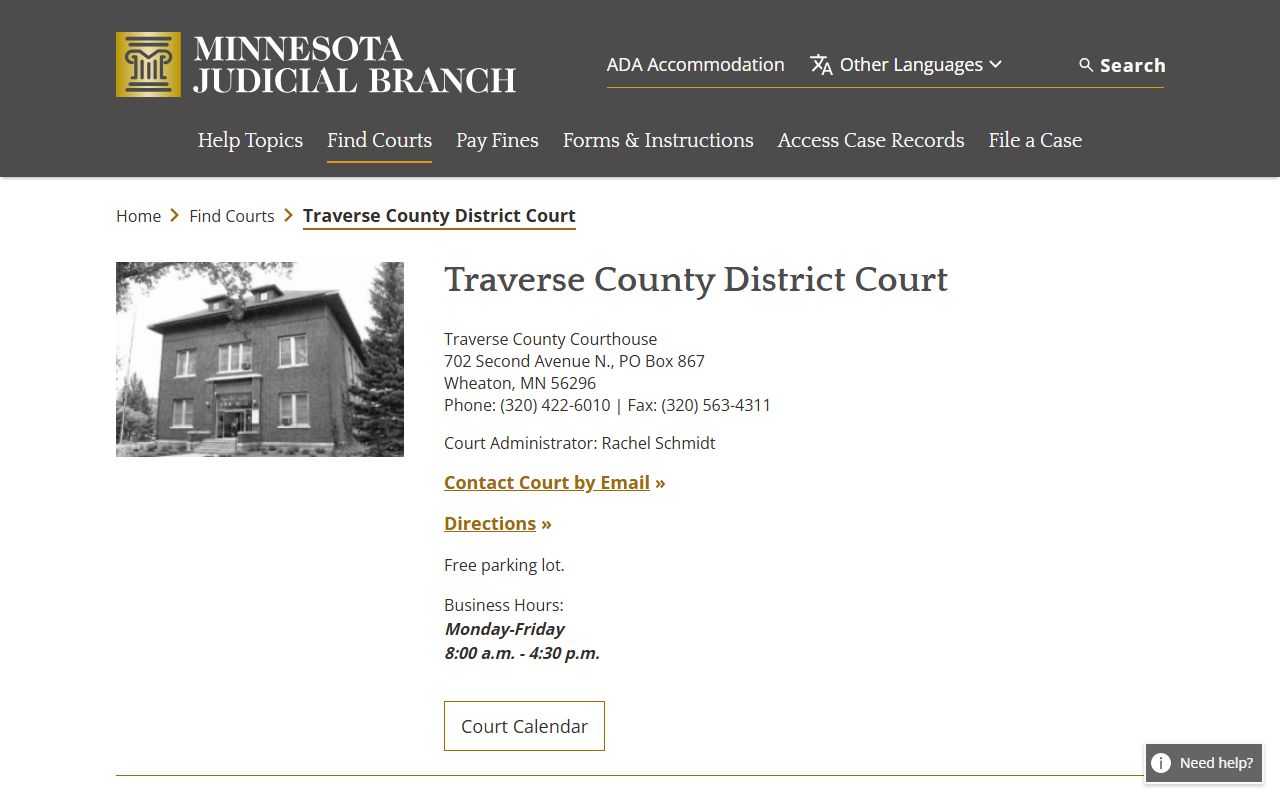
After a jail arrest, this court office is the local source for certified copies and for public records that are not fully available through remote access.
How to Find Court Records After an Arrest in Traverse County
The online starting point is Minnesota Court Records Online, usually called MCRO. MCRO is statewide, so the county filter matters. A name search can return people with similar names from other counties, and Traverse County's jail may also hold people for outside agencies. Compare the MCRO result against the booking date, roster charge language, warrant information, and holding agency before assuming a match.
- Open MCRO and accept the terms and conditions.
- Search by defendant name when no court file number is known, or use the case number if it appears on paperwork.
- Select Traverse in the county list when the case should be a Traverse County District Court case.
- Open the case details and register of actions to review filed charges, events, hearings, conditions, and documents that are public online.
- If the case is not online or documents are limited, contact Traverse County Court Administration or use a courthouse public access terminal.
The Minnesota Judicial Branch access page explains that MCRO is not the same as a certified court record. Certified copies and some civil judgment search results must be obtained from court administration. Some records available at courthouse terminals are not available remotely.
The MCRO case search screen is the place where a Traverse filter, party name, case number, citation number, or attorney search can be used.
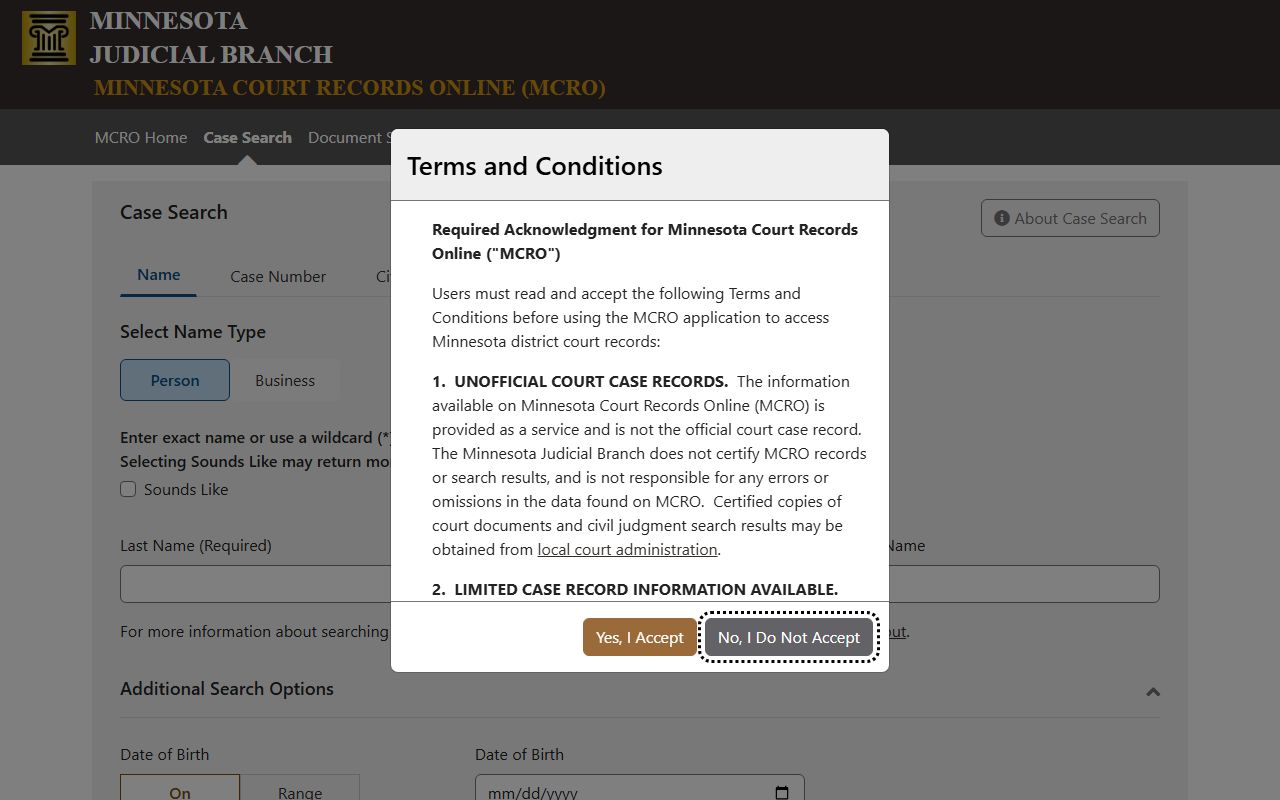
For court records after a jail arrest, MCRO should be read alongside the roster rather than as a replacement for it.
MCRO Search Fields for Court Records After Arrest
MCRO has several search routes. A person looking from the jail side usually starts with name and county because the booking record may not list a case number yet. When the court case has opened, the case number is the cleaner search path.
| Field Label | Type | Required | Options / Format Notes |
|---|---|---|---|
| Terms and Conditions acknowledgment | Checkbox or button workflow | Yes | Access starts only after the user accepts MCRO terms. |
| Name (Person or Business) | Search option | Optional | Useful after arrest if the court file number is not known. |
| Case Number | Search option | Optional | Best when a filed court number appears on paperwork or notices. |
| Citation Number | Search option | Optional | Useful for citation-based traffic or criminal matters. |
| Attorney Name or Bar Number | Search option | Optional | Can help locate cases tied to a known attorney. |
| County List / Search by County | Filter | Optional but important | Select Traverse to narrow statewide district-court results. |
| Find | Button | Yes to execute | Runs the selected county or search-field query. |
| Clear | Button | No | Clears selected fields before a new search. |
How Charges Get Filed After an Arrest: Complaint, Information, and Indictment
Booking at the Traverse County Jail / Traverse County Detention Center records custody. Charging begins when the prosecutor files a document in court. Minnesota criminal cases commonly begin by complaint, but readers may also see information or indictment language in criminal procedure materials. The important distinction is that a roster charge is the arrest or hold description, while the filed charging document is what starts or defines the court case.
| Document | Filed By | Common Use | What It Does |
|---|---|---|---|
| Complaint | Prosecutor, based on law-enforcement reports and probable-cause material | Common Minnesota criminal charging document | Opens or supports the filed criminal case and lists formal counts. |
| Information | Prosecutor | Used in some felony-level charging procedures | States the formal accusation without relying on the roster text alone. |
| Indictment | Grand jury | Serious felony matters when grand-jury charging is required or used | Accuses the defendant through a grand-jury process. |
Charge Status in Court Records After a Jail Arrest
Charges can change as the case moves. A roster entry may show a bench warrant, probation hold, statute number, or agency hold, while the court file may later show different formal counts. Prosecutors can file charges as first reported, amend them, reduce them, add counts, dismiss counts, or replace the initial theory with a different charge supported by the record.
| Status | What It Means |
|---|---|
| Pending | The charge remains active and has not reached final disposition. |
| Amended / Reduced | The formal charge was changed, often to a different count, level, or factual theory. |
| Dismissed | The court record shows that the count was ended without a conviction on that count. |
| Convicted | The record reflects a guilty plea, verdict, or other finding of guilt on that charge. |
| Probation Revocation | The court activity concerns an alleged violation of an existing sentence or probation term, not always a new criminal count. |
Bond and Release After an Arrest
The Traverse County roster has a Conditional Bail Amount column. Research observed one cash/surety entry tied to Grant County District Court, which matters because the Wheaton jail may hold someone for another agency or court. Minnesota Rule of Criminal Procedure 6 governs release from custody, conditions of release, citations, and bail. Minnesota General Rule of Practice 702 governs the approval framework for appearance-only bail bonds in district court.
The practical local sequence is to read the roster bail column, call the jail at 320-422-7800 to confirm the current amount and any holds, then check MCRO for court conditions and hearing activity. If the roster identifies another court, such as a Grant County District Court bond line, the issuing court or agency may control the release terms.
| Bond Type | How It Works |
|---|---|
| Cash Bond | Money is posted to secure court appearance and is handled under court rules after case activity and obligations. |
| Surety Bond | An approved bail bond agent or surety posts an appearance bond under Minnesota court approval rules. |
| Conditional Release | The court may require no contact, sobriety, testing, supervision, travel limits, or other conditions. |
| PR / Own Recognizance | Release is based on the defendant's promise to appear, sometimes with conditions. |
| No-Bond Hold | Payment alone will not release the person until a court or holding agency acts. |
Warrants That Lead to an Arrest
Traverse County publishes a sheriff warrant page and a linked Warrant Wednesday PDF. The warrant PDF is a public list rather than a searchable portal, so browser or PDF search is the fastest online method. The inspected warrant format included a front mugshot column, name, date issued, and charges. A warrant can become a jail booking after arrest, appearance, or pickup, and the jail roster may then show Bench Warrant as the held-for reason.
Use the sheriff warrant page for the online warrant source, but confirm an active warrant with the sheriff at 320-422-7800 before acting on it. Warrants can be recalled, quashed, paid, or resolved after a PDF is posted. MCRO is the court fallback when the question is which case generated the warrant or failure to appear.
Charges vs. Convictions
An arrest and a filed charge are not convictions. Court records after a jail arrest may show accusations for months before the case is resolved. The disposition line, plea, verdict, dismissal, or sentence is what tells the reader whether a charge became a conviction.
| Charge | Conviction | |
|---|---|---|
| Stage | An accusation filed or pending in court | A guilty plea, verdict, or other finding of guilt |
| Source | Charging document, roster clue, warrant, or register of actions | Disposition, plea, verdict, judgment, or sentencing entry |
| What It Proves | That the case alleged an offense | That the court reached a guilt-based outcome on that count |
Sealed vs. Expunged Court Records After Arrest
Minnesota expungement law is found in Minn. Stat. Ch. 609A. The research source supports discussing expungement as sealing or limiting access to criminal records, including statutory and automatic expungement provisions where eligible. Do not assume a Traverse County booking, dismissed charge, or old warrant disappears from every system automatically. Court records, jail data, prosecutor records, and agency data may be controlled by different rules and offices.
| Sealed | Expunged | |
|---|---|---|
| Public Visibility | Public access is limited or hidden by court order or statute. | Access is sealed or limited under Minnesota expungement provisions when eligible. |
| Agency Access | Some government or justice-system access may remain depending on the order and law. | Eligibility and remaining access depend on Minn. Stat. Ch. 609A and the specific record. |
| Best Source | Review the district court order and MCRO/court administration status. | Use the court record and statute, and seek legal advice for eligibility questions. |
Restricted Court Records After an Arrest in Traverse County
MCRO remote access has limits. The Judicial Branch access materials explain that MCRO information is unofficial and that some records available at courthouse terminals are not available online. Remote restrictions can affect domestic abuse or order-for-protection and harassment restraining order case types because of federal VAWA limits, child protection and certain juvenile delinquency felony 16 case types, public documents in civil commitment case types, and party street addresses or comment fields in all case types.
For law-enforcement and detention data, Minnesota public-access rules also have limits. Minn. Stat. 13.03 is the general access rule, Minn. Stat. 13.82 covers law-enforcement data, and Minn. Stat. 13.85 covers corrections and detention data that may be private or confidential for medical, psychological, safety, security, investigative, or informant-sensitive reasons. If a record is not online, use the originating office rather than assuming it is public or unavailable.
Prosecutor and Court Contacts
For filed case records, certified copies, and non-remote public court access, contact Traverse County Court Administration at 702 2nd Ave. N., P.O. Box 867, Wheaton, MN 56296, phone 320-422-6010. For prosecutor identity, the Traverse County Attorney is Matt Franzese, 202 8th St. North, P.O. Box 807, Wheaton, MN 56296, phone 320-422-7795. For current custody, booking status, or a roster bail entry, the Traverse County Jail / Traverse County Detention Center and Sheriff's Office are at 203 7th Street North, Wheaton, MN 56296, phone 320-422-7800.
Important: This private site is not a consumer reporting agency under the FCRA, and information here may not be used for FCRA-covered decisions.